

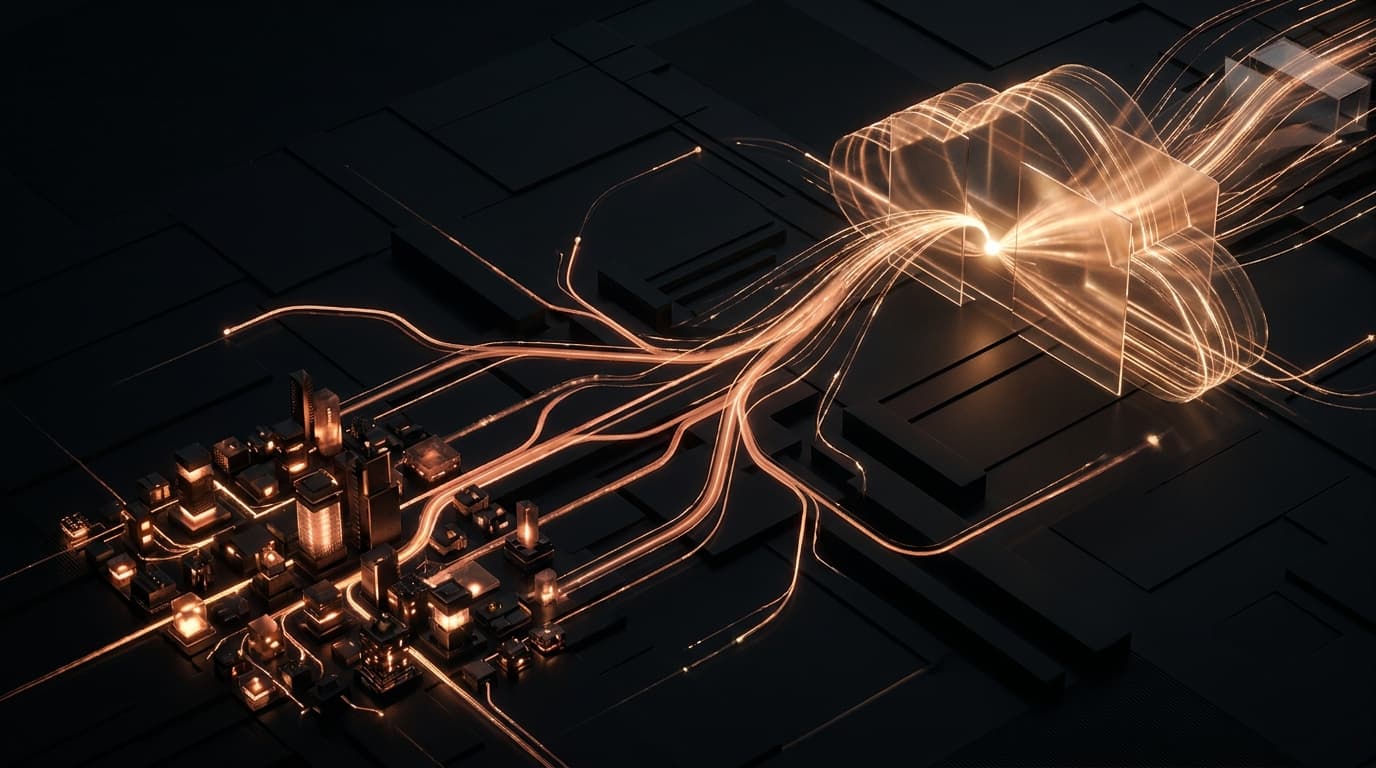
Perplexity AI, now valued at over $20 billion, unveiled what it calls the first hybrid local-server inference orchestrator at Computex 2026 on Monday night. The system autonomously decides — in real time, mid-task — which AI workloads stay on a user's device and which get routed to frontier models in the cloud. CEO Aravind Srinivas demonstrated the system onstage alongside Intel CEO Lip-Bu Tan, processing confidential deal materials where the AI itself chose what stayed local and what went to the cloud.
This is not another "run AI locally" announcement. Dozens of tools already do that. The significant shift is that Perplexity's system makes the routing decision itself, task by task, without requiring anyone to choose in advance. For business owners who've been stuck between the privacy risks of cloud AI and the capability limits of local models, that automatic orchestration layer is the piece that's been missing.
What the hybrid orchestrator actually does
The system works as an intermediary between the user and Perplexity's multi-model architecture. When a task comes in, a lightweight local model evaluates its sensitivity and complexity, then routes accordingly. Simple operations — summarisation, formatting, lightweight classification — run locally without touching the cloud. Complex reasoning, multi-step analysis, or retrieval-augmented generation across large datasets gets sent to frontier cloud models. The routing happens in real time, invisible to the user.
Critically, the system asks for user permission before sending sensitive tasks to the cloud, a design choice that directly addresses the data governance anxiety that keeps many enterprises from adopting agentic AI at all.
"No product has done this before," a Perplexity spokesperson told VentureBeat. The feature builds on Perplexity Computer, the company's agentic system launched in February that orchestrates 19 different AI models, and Personal Computer, a Mac-native agent introduced in March. The hybrid inference layer — arriving in July — extends both products from choosing which model to choosing which physical location processes each subtask.
The cost crisis driving this
Srinivas framed the announcement squarely around economics. "You don't want all your compute centralised in servers and everything running through the largest models," he said in a Bloomberg Television interview. "You're already reading reports of how people are freaking out about their cost. Some people are spending half a billion dollars per month. What you actually want is efficient value per watt per user."
That reference is not hyperbole. We covered Uber burning through its entire 2026 AI budget in four months after rolling out Claude Code to 5,000 engineers. The inference cost problem is real and getting worse: IDC forecasts a tenfold increase in enterprise agent usage by 2027, with token and API call loads rising a thousandfold.
Perplexity's own financial trajectory underscores why this matters. The company's annualised recurring revenue surged past $450 million in March 2026, with a target of $656 million by year-end. Srinivas noted that revenue grew fivefold while headcount increased just 34% — but serving those users means serving their inference costs too. Offloading a meaningful share of compute to the billions of PCs already in circulation is as much a margin play for Perplexity as it is a privacy feature for users.
The hardware that makes this possible
The timing of the announcement is strategic. Computex 2026 has been dominated by a single theme: on-device AI capable enough to matter.
Hours before the Intel keynote, Nvidia CEO Jensen Huang unveiled the RTX Spark, a new Arm-based superchip featuring a Blackwell GPU with 6,144 CUDA cores, up to 128GB of unified memory, and 1 petaflop of AI performance. Nvidia describes it as the first Windows PC purpose-built for personal AI agents — capable of running 120-billion-parameter models with a million tokens of context, locally, without a single API call to the cloud. RTX Spark laptops and desktops ship this autumn from ASUS, Dell, HP, Lenovo, and Microsoft Surface.
Intel, meanwhile, used its keynote to position Core Ultra Series 3 as the client silicon that makes hybrid inference possible on the PC side.
Perplexity's orchestrator sits at the intersection of both strategies. If it works as advertised, it creates a direct economic incentive for businesses to invest in more powerful local hardware. The more capable the device, the more inference runs locally, the lower the cloud bill. That feedback loop benefits every chipmaker competing for AI PC sockets — and it gives Perplexity a route to reducing its own server costs as users upgrade their hardware.
"As chips become more powerful, more intelligence moves onto a person's machine, alongside server inference for the complex tasks that still need frontier models," a Perplexity spokesperson told VentureBeat. "Sensitive and sovereign work can stay local, which changes the need for massive country-level infrastructure."
What this means for your business
If you're running a business that handles sensitive client data — financial records, health information, legal documents, HR files — this is the development worth paying attention to. The hybrid inference model addresses the exact tension that at Heygentic we hear most often from clients: "We want AI to handle complex work, but we can't send our data to someone else's servers."
Perplexity's approach is one answer, but the broader pattern matters more than any single product. We've already covered Dell's deskside AI push claiming 87% cost savings over cloud-only inference. The convergence is clear: the industry is moving toward hybrid architectures where an intelligent routing layer decides what stays local and what goes to the cloud, optimised for cost, privacy, and capability.
For a business running 10–50 people, the practical implications are:
- Privacy without compromise. You no longer need to choose between keeping data on-premises (limited AI capability) or sending it to the cloud (privacy risk). Hybrid systems handle both, automatically.
- Cost predictability. Instead of an open-ended cloud bill that scales with usage, a meaningful share of inference runs on hardware you already own. The variable cost shrinks.
- Regulatory readiness. With the EU AI Act taking effect in August 2026 and Australian AI regulation timelines tightening, being able to demonstrate that sensitive data never left your device is a compliance advantage.
What to watch
Perplexity's demo was controlled and ran on Intel's best silicon. The hard questions remain unanswered: how does the routing logic handle underpowered hardware? What happens when network connectivity is unreliable mid-task? How accurately can a lightweight local model assess data sensitivity in real time — and what's the failure mode when it gets it wrong?
The competitive response also matters. Apple Intelligence already routes some tasks locally via Private Cloud Compute. Google's Gemini Nano runs on-device. Microsoft's Copilot+ PCs are built around local inference. None currently offer the autonomous, task-level routing Perplexity is claiming, but they all have the engineering talent and distribution to build it.
The feature launches in July. If it works reliably, it establishes a new baseline for what AI tools should offer: intelligent, automatic allocation of compute based on what the task needs and what the data demands. If it doesn't, it remains a compelling proof of concept that someone else will eventually get right.
Either way, the cloud-only era of AI inference is ending. The question is no longer whether AI will run on your machine — it's whether the software is smart enough to decide when it should.
Sources
- Perplexity AI unveils hybrid local-cloud inference system at Computex 2026 — VentureBeat
- Perplexity splits AI inference between PCs and cloud to cut costs — The Next Web
- Perplexity Computer adding ability to split tasks between local and cloud models — 9to5Mac
- Computex 2026: An Intelligent World Built on Silicon — Intel Newsroom
- NVIDIA and Microsoft Reinvent Windows PCs for the Age of Personal AI — NVIDIA Newsroom
- Agent Adoption: The IT Industry's Next Great Inflection Point — IDC
- Local-First AI Agents: Hybrid Cloud-Edge Architectures — Zylos Research
